

A second home on your lot
ADUs and ʻOhana Units in Hawaii
A second, permitted home on the lot you already have, for your kids, your parents or a long-term tenant. We check your lot first, free.
- Free lot check, no pressure
- One written price, delivered and installed
- Built by a licensed Hawaiʻi contractor
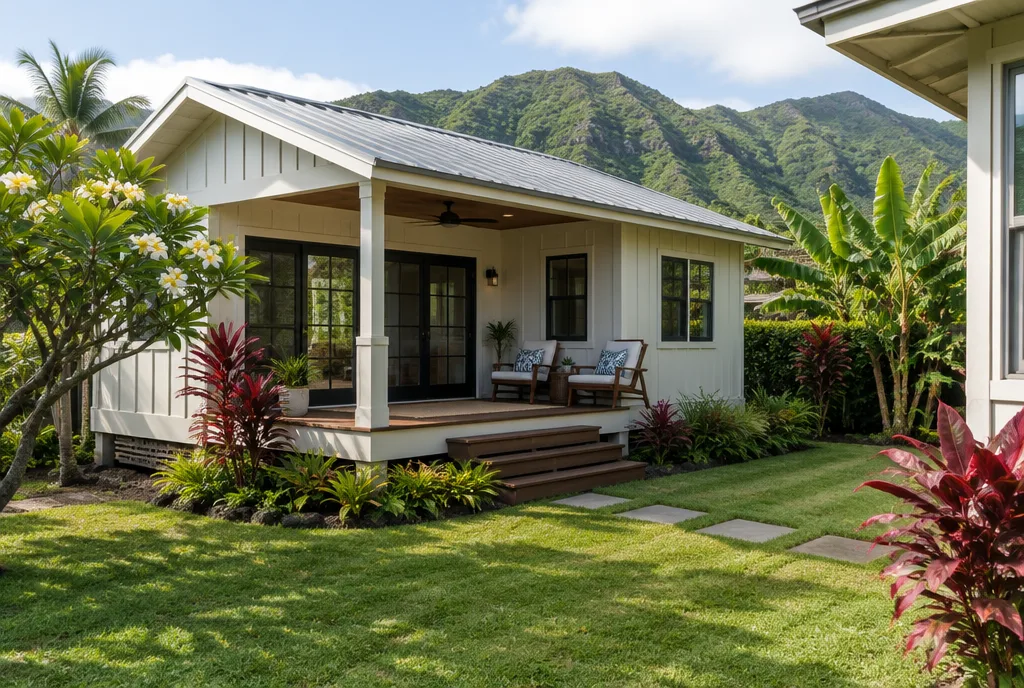
- Planned around your lot and house
- Family close, with their own door
- Permits and inspections handled
- Financing partners available
The short answer
What is an ADU in Hawaii?
An ADU, or accessory dwelling unit, is a second, self-contained home on a lot that already has a house. In Hawaiʻi, one built for family is often called an ʻohana unit. A 2024 state law, Act 39, requires every county to allow at least two ADUs, or the reasonable equivalent, on residentially zoned lots by December 31, 2026. On Oʻahu, an ADU can already be up to 1,000 square feet on a lot of 5,000 square feet or more. Every ADU is subject to county permit and Department of Health wastewater approval.
What fits on your lot depends on its zoning and size, the house already there, and how water and wastewater reach both homes. The free lot check tells you before you pay anything.
Which one is it?
ADU, ʻohana unit, guest house or tiny home?
People use these words for the same thing, but the county doesn’t. Which one your second home counts as decides who can live in it, whether you can rent it out and how big it can be.
| Name | What it is | Who can live there | Renting it out |
|---|---|---|---|
| ADU | Accessory dwelling unit: a second, self-contained home on a lot with a house. | Anyone, under your county’s rules. | Long term only on Oʻahu. Not as a vacation rental in Maui County. |
| ʻOhana unit | A second home meant for family. | On Oʻahu, relatives of the family in the main house. | It’s built for family, not for renting to the public. |
| Guest houseGuest house rules in full | A word people use for many things. | Depends on your county. | Ask first. We’ll tell you whether yours would count as a separate home. |
| Tiny home | A size, not a permit type. Kauaʻi’s code treats 500 sq ft or less, not counting lofts, as a tiny house. | On a foundation and permitted, it can be your ADU or ʻohana unit. | The same rules as the permit it’s built under. |
A tiny house on wheels isn’t a permanent home on its own. To live in one, plan on a foundation and a permit.
Rules by island
Hawaii ADU rules, island by island.
Act 39 set one deadline for the whole state, but each county writes its own rules. Here’s where each one stands as of October 2026.
| Name | Where things stand | What it means for you |
|---|---|---|
| OʻahuCity & County of Honolulu | Ordinance 25-2, mostly in effect since September 30, 2025: one ADU plus one ʻohana unit with a detached house, up to three homes on one lot. An ADU can be up to 500 sq ft on a lot under 5,000 sq ft, and up to 1,000 sq ft on a larger lot. ADU building permit, plan review and wastewater facility charges are waived through June 30, 2030. | Many single-family lots can take a second home now. Lot size, sewer and access decide how big. |
| Maui CountyMaui, Molokaʻi, Lānaʻi | Ordinance 6013, adopted July 8, 2026, is the county’s two-ADU law under Act 39. Ordinance 5966, adopted March 20, 2026, changed ADU and deck sizes on lots under half an acre. | New rules, still settling in. We check the current size limits and conditions for your lot. |
| Big IslandHawaiʻi County | Bill 123, signed in October 2024, allows up to three ADUs where zoning allows, each up to 1,250 sq ft of living space, as reported when it was signed. Its building code also has rules for tiny houses on a foundation. | Many lots can take more than one ADU. Water and wastewater are often what decide it. Farm land has its own rules. |
| KauaʻiKauaʻi County | The county must adopt its two-ADU rules by December 31, 2026, under Act 39. Its code treats a home of 500 sq ft or less, not counting lofts, as a tiny house (§12-2.4). | We check the current ADU and guest house rules for your lot. |
Every ADU is subject to county permit and Department of Health wastewater approval. Rules change often, so we check yours during the lot check.
Sources: Act 39, SLH 2024; City & County of Honolulu Ordinance 25-2 and its 2025 ADU fee waivers; Maui County Ordinances 5966 and 6013; Hawaiʻi County Bill 123 (2024, as reported by Big Island Video News, October 9, 2024) and Hawaiʻi County Code ch. 5B; Kauaʻi County Code §12-2.4. Last reviewed October 2026.
Who it’s for
Family close by, with their own door.
A home for your grown kids
So they can stay in Hawaiʻi, on family land, with a front door of their own.
A place for your parents
One level and a few steps away. Some call it a granny flat or a mother-in-law suite. Here it’s often an ʻohana unit.
Downsize and stay put
Move into the smaller home and rent the main house long term, where your county allows it.
Family coming home
For relatives moving back to the islands, or for someone in the family starting over.
How it works
How to build an ADU in Hawaii.
Five steps, one team. In Hawaiʻi the permit usually takes longer than the build, so you get a written timeline with your price.
Step 1: Free lot check
Tell us your island, your lot and what’s on it now. We look at zoning, lot size, setbacks, your septic or sewer, water, power and access past the main house, then tell you what you can build. No cost and no pressure.
Step 2: Design and one written price
We plan the ADU around your lot and the house already there: where it sits, how both homes keep their privacy, and who will live in it. You get one written, all-in price.
Step 3: Permit
We draw the plans and file the permit, including any ADU or ʻohana paperwork the county asks for.
Step 4: Build and site work
Your home is built to order while the site is prepared: foundation, wastewater, and power and water lines. Licensed electricians and plumbers do their part, and your payments follow the work.
Step 5: Deliver, install, final inspection
The home is delivered to your island, set on its foundation and hooked up. We stay through the final inspection.
Wondering if your lot can take a second home? Ask us.
The lot check is free and takes one phone call. You’ll get a straight answer about what you can build, even if you never build with us.
Cost
What an ADU costs in Hawaii.
An ADU’s price depends less on the home than on your lot. The house already there decides how wastewater, power and water reach the new home, and how it gets delivered. That’s why your written price comes after the lot check.
Included in your written price
- Design and plans for your lot and the house already there
- Filing the permit and the county paperwork
- The home, built to order
- Delivery to your island and setting it on your lot
- Licensed electrical and plumbing hookups
- Seeing it through the final inspection
Depends on your lot
- Whether your septic can serve two homes, or a new system or sewer connection is needed
- A separate electric meter, or a line from the main house
- Water service to the new home
- The type of foundation
- Access for delivery past the main house
- Any parking space the county requires
Not included
- The land. We build on land you or your family already own.
- Changes to the main house
- Furniture and décor
Paying for it
We work with financing partners, and many families also use savings or the equity in their main home. On Oʻahu, ADU building permit and plan review fees are waived through June 30, 2030.
Made to live in
Its own home, a few steps away.
An ADU sits close to your door, so it should still feel like a home of its own. We plan where it sits on the lot, which way the doors face and how each home keeps its privacy.
For parents, that can mean one level, no steps at the entry, wider doors and a roll-in shower. For grown kids, a second bedroom and a small deck of their own.
Its own entrance
Privacy for both homes, on the same lot.
Sized to your lot
As big as your county allows and your budget wants.
Easy to live in
One level, wide doors and a walk-in or roll-in shower.
Questions
ADU questions, answered.
Can I build an ADU on my lot in Hawaiʻi?
Often, yes. Act 39 (2024) requires every county to allow at least two ADUs, or the reasonable equivalent, on residentially zoned lots by December 31, 2026. Whether yours qualifies depends on zoning, lot size, the house already there, and water and wastewater. Agricultural land has its own, tighter rules. The free lot check tells you which apply to yours.
How big can an ADU be?
It depends on your county and your lot. On Oʻahu, an ADU can be up to 500 square feet on a lot under 5,000 square feet, and up to 1,000 square feet on a larger lot (Ordinance 25-2). In Maui County, the limit runs from 720 square feet on most house lots up to 1,200 on lots over two acres. On the Big Island, Bill 123 (2024) allows up to 1,250 square feet of living space. Kauaʻi is updating its rules, so we check the current limit for your lot.
Can I rent out my ADU?
Long term, often yes. As a vacation rental, generally no. On Oʻahu, ADUs can only be rented long term, and in Maui County they can’t be used as vacation rentals. Rules differ by county and change often, so ask us about your lot before you count on rental income.
Can a tiny home be my ADU?
Yes, if it sits on a permanent foundation and is permitted as a home. A tiny house on wheels isn’t a permanent home on its own. Each of our custom tiny homes is designed for its lot, so it can be built as an ADU or an ʻohana unit.
Can I have both an ADU and an ʻohana unit?
On Oʻahu, yes. One ADU plus one ʻohana unit can go with a detached single-family house, for up to three homes on one lot, if the lot qualifies. The other counties are setting their own rules under Act 39, so we check yours.
Do I have to live on the property?
It depends on your county, and on Oʻahu the rules on this changed recently and sources disagree. We check the current rule for your lot before you commit to anything.
Can my HOA or neighbors stop me?
Act 39 also limits some private covenants that ban ADUs, but how it applies depends on your covenant and when it was recorded. Read your HOA rules before you start, and bring them to the lot check.
Can my septic serve two homes?
Sometimes. Every new home needs approved wastewater, whether that’s your sewer, an upgraded septic system or a new one, and the Department of Health has to approve it. We check this early, because it’s one of the biggest cost differences between lots.
How long does it take to build an ADU?
The permit is usually the longest part, and the time depends on your county. The build itself is shorter. You get a written timeline with your price, so you know what to expect before you sign.
Free lot check
Start with your lot.
Tell us your island, what’s on your lot now and who the second home is for. We’ll call you back to talk through what you can build. It’s free, and there’s no pressure to go further.
(808) 000-0000